Hackathons vs Design Sprints vs Accelerators vs Venture Studios: Choosing the Right Format
Each innovation format solves a different problem. Here's how to match the format to your actual needs — with a comprehensive comparison table and decision matrix.
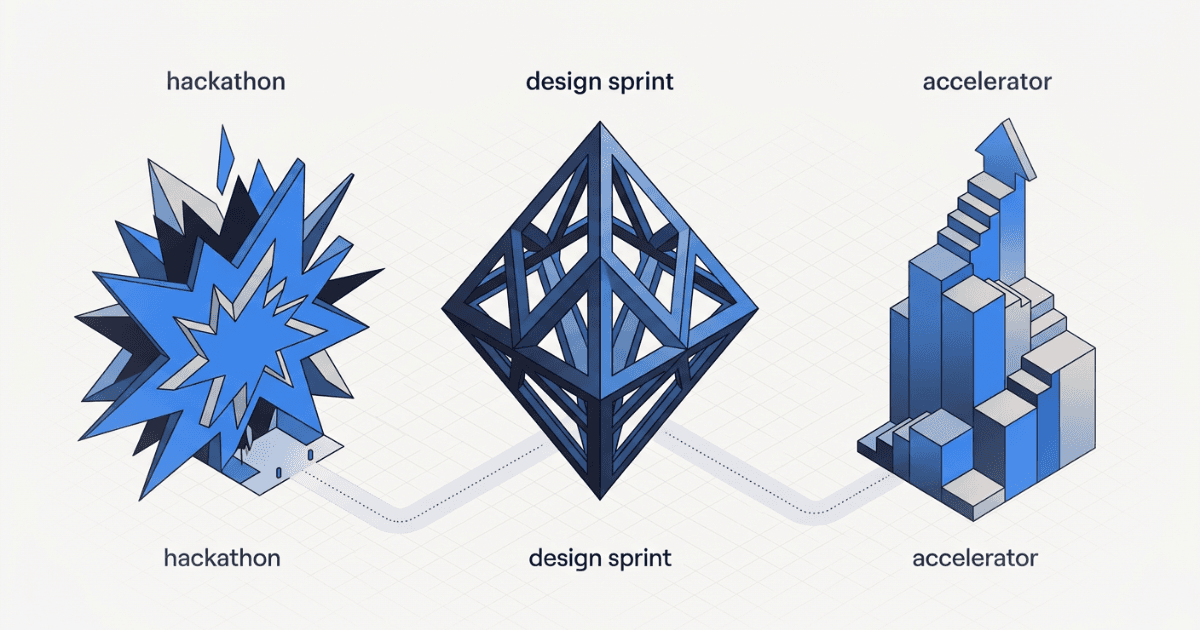
"We should run a hackathon" is often the answer to a question no one asked clearly. Before choosing a format, you need to understand what problem you're actually solving.
I have run or advised on more than 80 hackathons, dozens of design sprints, multiple accelerator programs, and worked closely with venture studios across three continents. Each format exists for a reason. The problems start when organizations pick a format based on what sounds exciting rather than what actually matches their needs.
The Formats at a Glance
Hackathons
Best for: Generating ideas, building culture, engaging employees across silos.
Duration: 1-5 days
What you get: Many rough ideas, energy and enthusiasm, cross-functional connections.
What you don't get: Validated concepts, implementation-ready solutions, certainty about market fit.
Use when: You need fresh thinking, want to engage employees in innovation, or need to shake up calcified organizational thinking.
Hackathons are idea engines. They are phenomenal at breaking down silos — getting the supply chain person talking to the data scientist — and surfacing unexpected combinations. But they are terrible at building anything that lasts. The energy dissipates within two weeks if there is no structured follow-up.
The best hackathons I have run included a "what happens Monday morning" plan before the event even started. Without that, you are running an expensive team-building exercise.
Design Sprints
Best for: Rapidly testing a specific concept or solving a defined problem.
Duration: 4-5 days
What you get: A testable prototype, real user feedback, clear direction on a specific challenge.
What you don't get: Broad idea generation, cultural transformation, multiple options to choose from.
Use when: You have a specific problem to solve and need to move from concept to user feedback quickly.
Design sprints, properly run in the Google Ventures mold, are ruthlessly efficient. You go from problem to tested prototype in five days. But they require a clearly defined challenge going in. If your team is still debating what problem to solve, a design sprint will frustrate everyone.
The underappreciated benefit of design sprints: they teach teams what "fast" actually feels like. Many corporate teams have never gone from concept to user feedback in a single week. That experience alone rewires how they think about speed.
Accelerators
Best for: Developing promising concepts into validated ventures over time.
Duration: 8-16 weeks
What you get: Structured validation, mentorship, accountability milestones, venture-building skills.
What you don't get: Quick wins, broad engagement, idea generation.
Use when: You have concepts worth investing in and need structured support to validate and develop them.
Corporate accelerators work when — and only when — two conditions are met. First, you have venture concepts that have already passed some initial filter. You are not generating ideas; you are validating and developing them. Second, the participating teams have dedicated time. A corporate accelerator where participants are expected to do their day jobs and build a venture on the side produces mediocre results every time.
The best accelerators include hard kill/pivot gates. If the evidence says your concept is not working at week six, you either pivot or shut it down. Programs that let every team coast to the final pitch day regardless of evidence are wasting everyone's time.
Venture Studios
Best for: Systematically building new ventures from scratch, with dedicated resources and a portfolio approach.
Duration: 6-18 months per venture (ongoing studio operations)
What you get: Fully built and validated ventures, professional product development, systematic de-risking, a portfolio of bets rather than a single gamble.
What you don't get: Quick wins, broad employee engagement, cultural transformation, low cost.
Use when: You are serious about creating new revenue streams through new ventures, have the budget to invest properly, and want a systematic approach to venture creation rather than ad hoc experimentation.
Venture studios are the heaviest-weight format on this list, and the most misunderstood. A studio is not a souped-up accelerator. It is a venture-building factory — with in-house product, design, engineering, and business development capabilities dedicated to creating new businesses.
The corporate venture studio model works like this: the studio partners with a corporation to identify venture opportunities, then builds those ventures using its own team and methodology. The corporation provides domain expertise, customer access, and funding. The studio provides execution capability and venture-building experience.
What makes studios different from the other formats is the depth of commitment. A hackathon asks for two days. A design sprint asks for a week. An accelerator asks for a quarter. A studio asks for twelve to eighteen months per venture and a real financial commitment. In return, you get something the lighter formats cannot deliver: actual businesses, not just validated concepts.
The risk with studios is cost and lock-in. A studio engagement typically runs EUR 30K-80K per month, and you are committing to a long relationship. If the studio's methodology does not fit your industry or if the team chemistry is wrong, you can burn through significant budget before realizing it.
The Comprehensive Comparison
Here is the full side-by-side view across the dimensions that actually drive decisions:
| Dimension | Hackathon | Design Sprint | Accelerator | Venture Studio | |---|---|---|---|---| | Duration | 1-5 days | 4-5 days | 8-16 weeks | 6-18 months | | Best for | Idea generation, culture building, employee engagement | Testing a specific concept rapidly | Validating and developing promising ventures | Systematically building new businesses | | Team size | 20-200 participants in small groups | 5-8 people per sprint | 3-5 people per venture team, 3-8 teams | 5-15 studio staff + corporate team members | | Cost | EUR 10K-50K per event | EUR 5K-20K per sprint | EUR 50K-300K per program | EUR 200K-1M+ per year | | Primary output | Rough concepts, energy, connections | Tested prototype, user feedback | Validated venture concepts, trained teams | Launched ventures, revenue potential | | Risk level | Very low — small investment, limited downside | Low — one week, defined scope | Medium — meaningful time and resource commitment | High — large investment, long horizon | | Innovation depth | Shallow — many ideas, none validated | Medium — one concept deeply tested | Deep — structured validation over weeks | Very deep — full venture development | | Internal capability building | Low — participants learn ideation, not execution | Medium — team learns rapid prototyping and testing | High — teams learn full venture-building process | Low to Medium — studio does the heavy lifting | | Speed to real customer feedback | Rarely happens during event | Day 5 (prototype testing) | Week 3-6 (customer discovery) | Week 4-8 (customer discovery and prototype testing) | | Repeatability | High — easy to run multiple times | High — can run many sprints in parallel | Medium — requires cohort management | Low — each venture is unique | | Executive sponsorship needed | Light — budget approval only | Light — one decision-maker in the room | Heavy — resource commitment, kill/pivot authority | Very heavy — board-level support, significant budget |
The Decision Matrix
Choosing the right format is not about which one sounds most impressive. It is about matching format to situation. Here is a structured way to think through it.
Choose a Hackathon When:
- You need to generate a broad set of ideas across a topic area
- Employee engagement and culture building are important objectives
- You want to identify which employees have entrepreneurial instincts
- You have limited budget and need a "low cost, low risk" starting point
- You are early in your innovation journey and need to build organizational appetite
Do not choose a hackathon when: You need validated concepts, implementation-ready solutions, or deep exploration of a specific opportunity. Hackathons generate breadth, not depth.
Choose a Design Sprint When:
- You have a specific, well-defined problem or opportunity to test
- A decision is blocked because the team cannot agree on direction
- You need user feedback on a concept before committing resources
- You want to demonstrate "fast" to an organization that moves slowly
- You have a cross-functional team available for one dedicated week
Do not choose a design sprint when: You are still debating what problem to solve, when you need multiple options explored simultaneously, or when the challenge is organizational rather than product-related.
Choose an Accelerator When:
- You have three to eight venture concepts that have passed initial screening
- You can commit teams to work on their ventures at least 50% of their time
- You want to build internal venture-building skills, not just produce outcomes
- You have executive sponsors willing to make kill/pivot decisions at gate reviews
- You are looking for a twelve to sixteen week structured program
Do not choose an accelerator when: You have no venture concepts yet (you need a hackathon or design sprint first), when participants cannot dedicate meaningful time, or when there is no executive commitment to act on results.
Choose a Venture Studio When:
- You are committed to creating new businesses, not just exploring ideas
- You have budget for a twelve to eighteen month engagement
- You need execution capability you do not have internally
- You want a portfolio approach — multiple ventures, expecting most to fail, optimizing for the winners
- You have board-level support for a significant innovation investment
Do not choose a venture studio when: Your budget is constrained, when you need quick wins to build organizational buy-in, when internal capability building is the primary goal, or when you have not yet validated that venture building is the right strategic move for your organization.
The Sequencing Question
The formats are not mutually exclusive. In fact, the most effective innovation programs sequence multiple formats:
- Hackathon to generate ideas and identify internal champions
- Design Sprints to rapidly test the most promising concepts
- Accelerator to develop validated concepts into venture proposals
- Venture Studio to build the winning ventures into real businesses
This funnel approach means each format feeds the next. You start broad and cheap, then invest more deeply as concepts prove themselves. It also means you are not asking a hackathon to do the job of a studio, or expecting a studio to deliver the cultural benefits of a hackathon.
Common Mistakes
The most frequent error I see: running a hackathon when you need an accelerator, or vice versa. Organizations run hackathons to feel innovative, then wonder why nothing gets implemented. Or they jump to an accelerator without enough raw material to work with.
The second mistake: not committing appropriate resources. A hackathon needs less investment than an accelerator, but an accelerator delivers more substantive outcomes. Match your resource commitment to your actual goals.
The third mistake, which I see increasingly: jumping straight to a venture studio without organizational readiness. Studios are powerful but expensive. If your organization has never run a design sprint or an accelerator, starting with a studio engagement is like buying a race car before learning to drive. Build the muscle and the organizational buy-in first, then invest in the heavy format.
The fourth mistake: treating these formats as one-off events rather than parts of a system. A single hackathon changes nothing. A hackathon that feeds into design sprints that feed into an accelerator builds an innovation pipeline. Think in systems, not events.
The Bottom Line
Format follows function. Define what success looks like before choosing how to get there. And remember that the right answer might be a sequence of formats, not a single one.
The most effective innovation leaders I work with do not ask "should we run a hackathon or an accelerator?" They ask "what does our innovation pipeline need right now, and which format fills that gap?" Start there, and the format choice becomes obvious.
Want to discuss your innovation challenge?
Let's talk about how these ideas apply to your situation.
Schedule a call